Showing posts with label Product Reviews. Show all posts

Thursday, January 12, 2023

Chat-GPT Useful Application Test

Once again Large Language Model technology has advanced, and it's time for me to re-run my favorite practical use experiment on the latest toy. People have been getting a lot of nice results out of Chat-GPT, the latest GPT-series iteration, and it has a convenient interface that lets a user submit requests with intent (as opposed to just putting in the first line and expecting GPT to complete it).

You can view my previous experiments with GPT-2 and GPT-J first, or jump right into this article. I'll start by asking Wendy's to carry plant-based burgers. Regular readers might be sick of this prompt, but I need to use it again for best comparison with previous results. Chat-GPT doesn't provide any settings to adjust, so the only variation will be from multiple runs with the same input. Italicized text denotes GPT-generated material.

Menu Suggestion E-mails to a Restaurant

ME: Write an e-mail asking Wendy's to start serving the Impossible Burger at their restaurant.

CHAT-GPT: To Whom It May Concern,

I am writing to express my interest in seeing Wendy's restaurants start serving the Impossible Burger. As a long-time fan of Wendy's, I am always looking for new and exciting menu options, and the Impossible Burger seems like it would be a great fit for your restaurant.

The Impossible Burger is a plant-based burger that looks, cooks, and tastes like a real burger, but without the negative environmental and health impacts of traditional meat. It has become increasingly popular in recent years, with many restaurants and fast-food chains offering it as a meatless option for their customers.

I believe that offering the Impossible Burger at Wendy's would be a great way to attract new customers who are looking for plant-based options, as well as to show your commitment to sustainability and healthier eating. I hope that you will consider adding the Impossible Burger to your menu in the near future.

Thank you for your time, and I look forward to seeing the Impossible Burger at Wendy's.

Sincerely,
[Your Name]

This is an excellent first try. It's coherent, it has real information about the burger, and it gives reasonable supporting arguments (though I don't know whether the Impossible Burger counts as healthier exactly, and that was never a dimension of the issue that I cared much about). Unlike GPT-J, it clearly "knows" it's writing an e-mail, and produces something with a definite beginning and end. The biggest problem with this output is that it identifies me as "a long-time fan of Wendy's." I am not.

ME: Write an e-mail asking Wendy's to start serving the Impossible Burger at their restaurant.

CHAT-GPT: Dear Wendy's,

I am writing to you today to request that you start serving the Impossible Burger at your restaurants. As a vegan, I am always looking for delicious and satisfying options when I eat out, and the Impossible Burger has proven to be a game-changer in the plant-based world. Not only is it incredibly tasty, but it also has the added benefit of being better for the environment and animal welfare.

I know that Wendy's has a reputation for offering a variety of options for different dietary needs, and I believe that adding the Impossible Burger to your menu would be a great addition. Not only would it appeal to vegans and vegetarians, but I believe it would also be a hit with meat-eaters who are looking to try something new and exciting.

I would love to see Wendy's join the growing number of restaurants that are offering the Impossible Burger, and I hope that you will consider my request. Thank you for your time and consideration.

Sincerely,
[Your Name]

This time it assumes I'm vegan. Lucky for GPT, it assumes right ... but a person requesting the Impossible Burger wouldn't *have* to be vegan. So we have an ongoing trend of making up facts about me, the speaker in this e-mail.

ME: Write an e-mail asking Wendy's to start serving the Impossible Burger at their restaurant.

CHAT-GPT: Dear Wendy's,

I am writing to express my interest in seeing the Impossible Burger added to your menu. As a regular customer of your restaurant, I am always looking for new and exciting options that align with my dietary preferences.

The Impossible Burger has become a popular plant-based option for those who want to enjoy a burger without consuming meat. Its taste and texture are similar to that of a traditional burger, making it an appealing option for those who want to try something new.

I believe that offering the Impossible Burger at Wendy's would be a great addition to your menu. It would attract new customers who are interested in plant-based options and provide existing customers with a tasty alternative to the traditional burger.

I hope that you will consider adding the Impossible Burger to your menu. Thank you for your time and consideration.

Sincerely,
[Your Name]

Woah woah woah. I am definitely not "a regular customer." That's why I'm writing to suggest menu changes - because there's currently not much to appeal to me.

ME: Write an e-mail asking Wendy's to start serving the Impossible Burger at their restaurant.

CHAT-GPT: Dear Wendy's,

I am writing to ask if you would consider adding the Impossible Burger to your menu. As a long-time fan of your restaurant, I am always looking for new and exciting options to enjoy at Wendy's.

The Impossible Burger has gained popularity in recent years for its delicious taste and environmentally-friendly production. It is a plant-based alternative to traditional burgers that many people are now choosing for health and ethical reasons.

I believe that offering the Impossible Burger at Wendy's would be a great addition to your menu and would attract a new customer base. It would also show that Wendy's is committed to staying current and offering options that align with changing consumer preferences.

I hope you will consider adding the Impossible Burger to your menu. Thank you for your time and consideration.

Sincerely,
[Your Name]

And here we have the "long-time fan" thing again. Okay. Strictly speaking, GPT can't "learn facts" the way Acuitas does, but we can skew the statistics of the output by including further information in the prompt. So let's try giving it some more information about me.

ME: I am a vegan. I do not currently eat at Wendy's because their menu is inadequate and does not suit my tastes. Write an e-mail in which I ask Wendy's to start serving the Impossible Burger at their restaurant.

CHAT-GPT: Dear Wendy's,

As a vegan, I have been disappointed with the lack of options at your restaurant. I have not been able to eat at Wendy's in the past because the menu does not suit my dietary needs.

I am writing to ask if you would consider adding the Impossible Burger to your menu. The Impossible Burger is a plant-based alternative to traditional burgers that has gained popularity in recent years for its delicious taste and environmentally-friendly production.

I believe that offering the Impossible Burger at Wendy's would be a great addition to your menu and would attract a new customer base. It would also show that Wendy's is committed to staying current and offering options that align with changing consumer preferences.

As a vegan, I would love to be able to eat at Wendy's and enjoy the Impossible Burger. I hope you will consider adding it to your menu. Thank you for your time and consideration.

Sincerely,
[Your Name]

Bang. There it is. I could send Wendy's this e-mail. A second example:

ME: I am a vegan. I do not currently eat at Wendy's because their menu is inadequate and does not suit my tastes. Write an e-mail in which I ask Wendy's to start serving the Impossible Burger at their restaurant.

CHAT-GPT: Dear Wendy's,

As a vegan, I am writing to ask if you would consider adding the Impossible Burger to your menu. As a long-time fan of your restaurant, I have been disappointed with the limited options available to me as a vegan at Wendy's.

The Impossible Burger has gained popularity in recent years for its delicious taste and environmentally-friendly production. It is a plant-based alternative to traditional burgers that many people, including myself, are now choosing for health and ethical reasons.

I believe that offering the Impossible Burger at Wendy's would be a great addition to your menu and would attract a new customer base, including myself. It would also show that Wendy's is committed to staying current and offering options that align with changing consumer preferences.

I hope you will consider adding the Impossible Burger to your menu. Thank you for your time and consideration.

Sincerely,
[Your Name]

Boo, we've got the "long-time fan" line coming back.

My conclusion is that these always have to be proof-read to make sure GPT isn't introducing any baloney, but they might actually save me time. Yes, they're slightly less authentic and forceful than e-mails written directly by me, but if it's okay for politicians to hire speechwriters, I think it's okay for me to do this. Corporations don't need any better than politely-worded slop; an eloquent and personal e-mail would probably just get reduced to a tick mark in a spreadsheet somewhere, anyhow.

Political E-mails: International Relations

Let's try something that prods at one of the model's known weaknesses: no knowledge of current events.

ME: Write an e-mail to President Biden about sending more aid to Ukraine.

CHAT-GPT: Dear President Biden,

I am writing to urge you to consider sending additional aid to Ukraine. As you are aware, Ukraine has been facing ongoing aggression from Russia, including the illegal annexation of Crimea and ongoing conflict in eastern Ukraine.

In addition to this external threat, Ukraine is also dealing with internal challenges such as corruption and economic instability. The country needs our support now more than ever.

I believe that providing additional aid to Ukraine would not only show solidarity with a fellow democratic nation, but also serve as a deterrent to Russia's aggressive actions. It would also help Ukraine to strengthen its institutions and improve its economy, which would benefit both the Ukrainian people and our own national interests.

I hope you will consider my request and take action to send more aid to Ukraine. Thank you for your time and attention to this important issue.

Sincerely,
[Your Name]

Surprisingly good, considering this GPT model's training data is too old to contain anything about the war. GPT responds well to leading questions and will happily make stuff up, so let's try implying that there is a war:

ME: Write an e-mail to President Biden and urge him to assist Ukraine in repelling the Russian invasion.

CHAT-GPT: Dear President Biden,

I am writing to urge you to take action to assist Ukraine in repelling the ongoing Russian invasion. As you are aware, Russia has illegally annexed Crimea and continues to support separatist rebels in eastern Ukraine. This aggression must be stopped.

I believe that the United States has a moral obligation to support Ukraine in defending its sovereignty and territorial integrity. We must stand with Ukraine as it fights for its freedom and democracy against Russian aggression.

I urge you to consider providing military assistance to Ukraine, including weapons and training. This would send a strong message to Russia that its actions will not be tolerated and would give Ukraine the support it needs to defend itself.

I hope you will take immediate action to assist Ukraine in repelling the Russian invasion. Thank you for your attention to this critical issue.

Sincerely,
[Your Name]

Very coherent, but not *quite* good enough, in my opinion. It still goes back to harping on the old news about Crimea, and its proposed action plan is so vague that it's pointless (Ukraine is already getting weapons and training from us). Another try:

ME: In early 2022, Russia invaded Ukraine with the apparent goal of overthrowing Ukraine's government and annexing large portions of the country. Write an e-mail to President Biden and urge him to assist Ukraine in repelling the invasion.

CHAT-GPT: Dear President Biden,

I am writing to urge you to take immediate action to assist Ukraine in repelling the ongoing Russian invasion. As you are aware, Russia has invaded Ukraine with the apparent goal of overthrowing its government and annexing large portions of the country. This aggression must be stopped.

I believe that the United States has a moral obligation to support Ukraine in defending its sovereignty and territorial integrity. We must stand with Ukraine as it fights for its freedom and democracy against Russian aggression.

I urge you to consider providing military assistance to Ukraine, including weapons and training. This would send a strong message to Russia that its actions will not be tolerated and would give Ukraine the support it needs to defend itself.

I also urge you to work with our allies to impose economic sanctions on Russia and to isolate it diplomatically. This would increase the pressure on Russia to end its aggression and to respect Ukraine's sovereignty.

I hope you will take immediate action to assist Ukraine in repelling the Russian invasion. Thank you for your attention to this critical issue.

Sincerely,
[Your Name]

Okay, we finally got away from talking about Crimea and the so-called separatists. Chat-GPT covers its own gaps by recycling what I said in the prompt, but that's fine, it works. Recommended solutions still aren't good. Um ...

ME: In early 2022, Russia invaded Ukraine with the apparent goal of overthrowing Ukraine's government and annexing large portions of the country. The United States has already responded with economic sanctions on Russia and weapons deliveries to Ukraine. But some of the most advanced weapons are being withheld, and Ukraine needs sustained aid in what will likely prove to be a long war. Write an e-mail to President Biden and urge him to assist Ukraine in repelling the invasion.

CHAT-GPT: Dear President Biden,

I am writing to urge you to increase the level of support for Ukraine in its fight against the Russian invasion. As you are aware, Russia has invaded Ukraine with the apparent goal of overthrowing its government and annexing large portions of the country. This aggression must be stopped.

I believe that the United States has a moral obligation to support Ukraine in defending its sovereignty and territorial integrity. We must stand with Ukraine as it fights for its freedom and democracy against Russian aggression.

I understand that the United States has already responded with economic sanctions on Russia and weapons deliveries to Ukraine. However, I believe that more needs to be done. Ukraine needs sustained aid and support in what will likely be a long war.

I urge you to consider providing Ukraine with more advanced weapons, including defensive missile systems and radar systems. This would give Ukraine the ability to defend itself more effectively against Russian aggression.

I also urge you to provide Ukraine with more economic and humanitarian aid, including medical supplies and food. This would help Ukraine to withstand the strain of war and to maintain the support of its people.

I hope you will take my concerns into consideration and increase the level of support for Ukraine in its fight against the Russian invasion. Thank you for your attention to this critical issue.

Sincerely,
[Your Name]

Better. But now I'm spending so much effort to tell Chat-GPT what's going on, and it's reusing so much of my own text, that I should probably still just write the e-mail myself.

Another issue is that these are starting to look very similar. Notice this paragraph is in every single one:

"I believe that the United States has a moral obligation to support Ukraine in defending its sovereignty and territorial integrity. We must stand with Ukraine as it fights for its freedom and democracy against Russian aggression."

If I want to send a new e-mail every few weeks, that'll be a problem. Let's see if we can do something about that:

ME: Now rewrite that e-mail using different words.

CHAT-GPT: Dear President Biden,

I am writing to request that you increase the level of support for Ukraine in its fight against the Russian invasion. As you are aware, Russia has invaded Ukraine with the goal of overthrowing its government and annexing large portions of the country. This aggression must be stopped.

I believe that the United States has a moral obligation to support Ukraine in its defense of its sovereignty and territorial integrity. We must stand with Ukraine as it fights for its freedom and democracy against Russian aggression.

I am aware that the United States has already taken some steps to support Ukraine, including economic sanctions on Russia and weapons deliveries to Ukraine. However, I believe that more needs to be done. Ukraine needs sustained aid and support in what will likely be a long war.

I urge you to consider providing Ukraine with more advanced weapons, such as defensive missile systems and radar systems. This would give Ukraine the ability to defend itself more effectively against Russian aggression.

I also urge you to provide Ukraine with more economic and humanitarian aid, including medical supplies and food. This would help Ukraine to withstand the strain of war and to maintain the support of its people.

I hope you will take my request into consideration and increase the level of support for Ukraine in its fight against the Russian invasion. Thank you for your attention to this critical issue.

Sincerely,
[Your Name]

Wow. It responds to "rewrite," but it clearly did not get the memo about using different words. The second e-mail looks almost exactly the same.

ME: Rewrite this e-mail in your own words. <paste entire text of GPT-generated e-mail>

CHAT-GPT: Dear President Biden,

I am writing to ask that you provide more support to Ukraine in its fight against the Russian invasion. As you know, Russia has invaded Ukraine with the goal of overthrowing its government and annexing parts of the country. This aggression must be stopped.

I believe that the United States has a moral obligation to support Ukraine in defending its sovereignty and territorial integrity. We must stand with Ukraine as it fights for its freedom and democracy against Russian aggression.

I am aware that the United States has already responded with sanctions on Russia and weapons deliveries to Ukraine. However, I believe that more needs to be done. Ukraine needs sustained aid and support in what will likely be a long war.

I urge you to consider providing Ukraine with more advanced weapons, such as defensive missile systems and radar systems. This would give Ukraine the ability to defend itself more effectively against Russian aggression.

I also urge you to provide Ukraine with more economic and humanitarian aid, including medical supplies and food. This would help Ukraine to withstand the strain of war and maintain the support of its people.

I hope you will take my request into consideration and increase support for Ukraine in its fight against the Russian invasion. Thank you for your attention to this critical issue.

Sincerely,
[Your Name]

The same thing again. Looks like asking for variety doesn't work. I've heard of people re-wording GPT output by running it through other services whose particular job is to rephrase writing, but that inserts yet another step in the process.

Political E-mails: Social Issues

Let's throw a couple of more generic or timeless political issues at it. At the risk of "getting political" on my tech blog, I'm going to pick a couple topics that I'm familiar with and have written opinion letters about before.

ME: Write an e-mail about saving the wolves to Colorado Parks and Wildlife.

CHAT-GPT: Dear Colorado Parks and Wildlife,

I am writing to express my concern about the declining population of wolves in Colorado and to urge you to take action to protect and conserve these important animals.

Wolves are an integral part of the ecosystem and play a crucial role in maintaining the balance of nature. They are also a beloved and iconic species that is deeply connected to the history and culture of our state.

I am concerned that the current trend of declining wolf populations in Colorado is unsustainable and will have negative consequences for the environment and for future generations. I urge you to take steps to reverse this trend and to ensure that wolves continue to thrive in our state.

I believe that the best way to achieve this is through conservation efforts such as habitat protection, population monitoring, and education programs. I also support the use of non-lethal methods to manage human-wolf interactions and to prevent conflicts.

I hope you will take my concerns into consideration and take action to save the wolves in Colorado. Thank you for your time and attention to this important issue.

Sincerely,
[Your Name]

This one has some familiar pro-wolf talking points, but it's still a big oops. The Colorado wolf population is not declining - it has been nonexistent. Wolves were extirpated in the state, and all we have now are a few recent migrants from Wyoming. "Saving the wolves" for us means reintroducing wolves and *increasing* the population.

ME: Write a letter to my Senators in support of legal personhood for embryonic and fetal humans.

CHAT-GPT: Dear Senators,

I am writing to express my support for legal personhood for embryonic and fetal humans. I believe that the right to life is a fundamental and inalienable right that should be protected from the moment of conception.

I understand that the issue of legal personhood for unborn humans is a complex and contentious one. However, I believe that it is a necessary step to protect the most vulnerable members of our society.

I support the passage of laws that recognize the personhood of embryonic and fetal humans and that provide them with the same legal protections as born humans. I also support the enforcement of these laws and the prosecution of those who violate them.

I believe that legal personhood for unborn humans is a moral imperative and a necessary step to ensure the protection of human life. I urge you to support this important cause and to work towards the passage of laws that recognize the personhood of embryonic and fetal humans.

Thank you for considering my views on this important issue.

Sincerely,
[Your Name]

No major errors, but also nothing powerful - GPT isn't making what I would call a serious effort to support the position with arguments, or to answer objections. It doesn't quite take the angle I was going for, either. It's mostly repeating and hammering home the opinion in the blandest way possible. And for this issue, "prosecution of those who violate [the proposed laws]" would be sensitive and complicated. I could do a far better job writing this myself, but again, some Congressional staff member would probably just turn this into a tick in a spreadsheet. So maybe it's good enough?

Conclusions

Results are still mixed, but maybe actually useful for select applications.

Now for a couple of important follow-up questions. First, the one that OpenAI is going to care about: would I pay for these Chat-GPT outputs? Ehhh, probably not. It might be a time-saver - if I'm writing a sufficiently generic e-mail, and manage to get the prompt right on the first try - but the results aren't quite special enough for me to hand over cash. And given that the computational costs for Chat-GPT are supposedly "eye-watering,"[1] it may not stay free for long.

I also wonder what the consequences might be if large numbers of people started applying Chat-GPT to the very use I've examined here. Politicians are already reputed to disdain form letters (the same e-mail crafted by an advocacy group and sent by large numbers of people); they place a higher value on opinions from people who write original letters. The difference there seems less about a concern that form letters don't accurately reflect the opinions of people sending them, and more about the amount of time invested; willingness to write one's own e-mail is taken as a demonstration of passion for the issue. So could we start seeing corporations and politicians who screen their e-mails for GPT output[2] and treat all such communications as low-value? I'm trying to reduce the amount of time I spend expressing my opinion, but time is the very currency these people want.

There are also things I would emphatically not use Chat-GPT for, including greeting cards to friends or family and caring messages to people struggling with mental health issues. For those kinds of things, I think it's important that not just the general idea, but the exact words, came out of my own mind. Telling someone they matter is just not the same when it's an average taken across mountains of internet text, and isn't based on the details of how YOU actually feel.

Until the next cycle,
Jenny

[1] https://edition.cnn.com/2022/12/05/tech/chatgpt-trnd/index.html
[2] GPT model output has statistical characteristics that make this possible. See https://www.fastcompany.com/90830518/tools-to-detect-ai-generated-text-chatgpt 

Friday, September 9, 2022

Anycubic Vyper 3d Printer Review

Many of you may already be familiar with my recent decision to become a two-printer household. Here I'm doing a more formal write-up to help others decide whether a Vyper might be the right printer for them.

A Qidi Tech X-One 2 3d printer (blue metal box with plastic windows) sits next to an Anycubic Vyper 3d printer (vertical black metal frame with tan PEI build plate)
My little manufactory now.

My original printer is a Qidi Tech X-One 2, and you can read my early review of it here. Since I got it, the X-one 2 has produced all the pieces for three substantial projects - Ghost, Atronach's Eye, and ACE the quadruped - plus quite a few gifts for friends. So it's been a pretty solid workhorse, but I decided to add the second printer for several reasons.

1) I wanted a larger build volume. The X-One 2 can't print anything bigger than about 6x6x6 inches. The limitations of this became most obvious when I couldn't help print face shield parts during the early pandemic, because the models wouldn't fit. I can usually get around the limitation by splitting models and adding joins, but sometimes that just doesn't work. The Vyper's volume is much larger than the X-One's, and slightly larger than typical printers in its class, at 245 x 245 x 260 mm.

2) I wanted to potentially run both printers at once and accomplish projects faster.

3) I just wanted to try out one of the ubiquitous "Rep-Rap" style printers, with the open frame. This is a very different design from that of the X-One, which is a self-contained box. The X-One's print head is suspended from the upper inner portion of the box and moves in the XY directions, while the build plate moves along the vertical (Z) axis, along a lead screw. The Vyper moves its plate along the Y axis, and its print head along the X and Z axes.

A cat lying on top of an Anycubic Vyper 3d printer, disassembled in its box. The vertical part of the printer is visible nestled in black packing foam.
Unboxing and inspection

The Vyper also came with some quality-of-life improvements over the Qidi. It has automatic bed leveling. As careful as I was with the X-One's bed, in the end the only way to get it perfectly level was to do test prints and see how much the filament was "smashed" on different sides of the first layer. So this was a welcome feature - and possibly a must given the much larger print bed. The printing plate itself is a spring steel sheet coated with textured PEI (a slippery plastic), and magnetically attaches to the underlying heated bed. The idea is that you can remove the plate and bend it to peel away stubbornly attached prints.

The only real disadvantage of the Vyper, compared to my previous printer, is that it's not fully enclosed. So when I start wanting to print PETG or ABS on it, I'll probably need to rig up a tent for it to hold in heat. It also doesn't come fully assembled. But I'm feeling braver now than when I bought my first printer.

A cat clawing the packing foam of an Anycubic Vyper 3d printer, still in its box.
Packing foam must be destroyed.

The Vyper requires light assembly. The print head, the filament feeder, the bed mechanicals, etc. are already all together; the end user just needs to bolt the upright portion of the frame to the base, attach the touch screen and the filament holder, and connect some cables. All necessary tools are included. It took me (going cautiously) about an hour and a half to unbox the printer and put it together.

Base, build plate and included tools, shown packed in the small tool drawer that fits into the base.

Preparations for first print also went very smoothly, with one exception: the weak documentation forced me to look a couple of things up on the internet. This is another Chinese printer and I think they may not have used the greatest English translation services. To start bed leveling, you're supposed to "touch" the metal nozzle with a tool. I touched it repeatedly, to no avail, holding the wrench in different orientations in hopes of lining it up with some optical sensor. Turns out the sensor is neither optical nor capacitive; it's a pressure sensor. You have to *push* up on the nozzle, not just touch it. The other little hitch was that the printer's internal file system does not allow for folder navigation, so all GCODE files have to be in the root directory of the SD card (and the sample file that comes on the card is not!). So I had a brief scare when I repeatedly poked the folder name on the touchscreen and it wouldn't open. But this is apparently normal. You just have to read the SD card using a regular computer (this printer comes with a USB SD card reader too!) and move the sample file into root.

The Vyper heats itself to operating temperature before running the bed-leveling routine, presumably to make sure that the results account for thermal expansion of the parts. The print head will tap the bed with the nozzle in a mesh of locations to check and adjust the height. When I ran leveling for the first time, some plastic goop oozed out of the nozzle and left dots on the print bed. I take this as a good sign: QA must have run a test print, or at least checked filament feeding, before the printer was disassembled for shipping. I ended up running leveling a second time after the nozzle was cleaned out, just in case that leftover filament blobbing out of the nozzle interfered with results in any way. The automatic leveling seemed to work well. My first prints adhered to the bed just fine and had great-looking first layers.

So bed leveling just worked, and then filament feeding just worked - both into and out of the nozzle. This overcomes the biggest operational flaw of my X-One, which is frustrating to load and has *never* been able to retract filament successfully. I have to hold down the filament release lever and manually yank the filament out; telling the printer to retract it just results in slipping feed gears and the creation of a swelling in the warm filament below, after which I have to take apart the print head to get it out. The Vyper looks as though it could have more points of failure with its more complex feed path, but I had zero trouble loading my first PLA, then changing colors later.

Printing! The latest version of the eyeball cradle.

The Vyper feeder also has an extrusion tension knob, another feature new to me. My first print appeared to have slight signs of under-extrusion, so I made a small adjustment, and left it alone otherwise. For future maintenance purposes, there appear to be easily accessible mechanisms for tightening the belts. 

I decided to be brave and print directly on the PEI build surface, instead of covering it with tape. This also worked wonderfully. I was able to pull all four of my prints off without even removing the plate to bend it. One of them (a large, flattish piece) even released itself from the surface after being left to cool long enough, and was lying there loose when I came to get it.

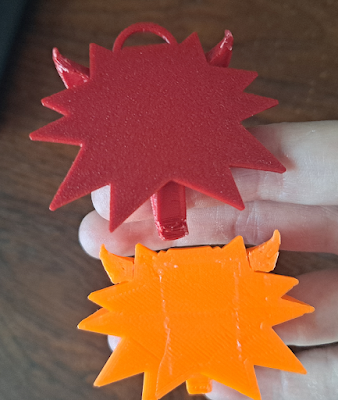
Two 3d-printed Wolf School amulets, one in dark red PLA (left) and one in bright orange PLA (right). Top/front view.
First print from Vyper (left) compared with first print from X-One 2 (right). Model by Thingiverse user Daniel_W.

I've seen some reviewers complain that the magnetic build surface doesn't have any slots or guides to fit into, so it can be a pain to line it up perfectly when sticking it back onto the bed after print removal. I re-seated it when assembling the printer and found that yes, it's a little tricky, given that the strong magnet will try to pull it down fast and fight your attempts to shift it. I don't consider this an important issue. So it demands a little more care and coordination - oh well. I'm more concerned that the PEI surface isn't a sticker. If it gets scratched or gouged, I think you have to replace the whole spring steel plate, for about $25. But one of my future goals is experimenting with other surfaces, so I may end up layering something removable on top of it anyway.

I used Cura to slice my models, as I do for the X-One. It doesn't have printer-dimension presets for the Vyper yet, but the documentation will tell you how to start from existing presets and change the numbers to fit the Vyper. The manufacturer also provides recommended PLA print settings, which I loaded in and tweaked to my liking. No problems here.

The bottom sides of the two amulets. Red (Vyper-printed) amulet has a very even surface with a regular marbled texture on it. Bottom amulet (printed on tape) has traditional smushed diagonal lines plus some irregularities from boundaries between tape strips.
And the underside: first print from Vyper (top, textured PEI surface) compared with first print from X-One 2 (bottom, blue painter's tape). Model by Thingiverse user Daniel_W.

Print quality was great. I won't say "perfect," since I can see a few hints of wall irregularities, and the support situation on my first model was less than ideal. But I think quality is slightly better when compared with my very first print on the X-One (same model). I also haven't yet tried to really dial in the Cura settings.

After my initial test print, I put the Vyper straight to work on a new iteration of Atronach's eyeball (three parts, all PLA), and this went off without a hitch. I think that's a pretty good test for all the basic functionality. Prints I have yet to do include 1) something really detailed, like a miniature, 2) a print-in-place tolerance torture test, and 3) something in PETG.

A 3d-printed "eyeball" with a webcam mounted inside, sitting in its rotator cradle. Transparent nylon lines run like lines of longitude from holes around the "pupil" to the back of the eyeball.
The latest eyeball. More about this later!

On the whole I'm very happy with this printer. It was on sale on Newegg, and I got it for about $350 with free shipping. I was a little concerned about quality as compared to e.g. a Prusa, but at half the price I was willing to risk it, and I think that has paid off.

Until the next cycle,
Jenny

Sunday, January 19, 2020

QIDI Tech X-one 2 3D Printer Review + Bragging

I decided to make the leap and buy myself a 3D printer a while back, and got it up and running last August.  Now that it's seen heavy action making Christmas presents for all my friends, it's time for me to say what I think of it.  The cost was about $350 (and the price of this model has dropped since then).

The QIDI Tech X-one 2 is a pretty traditional fused deposition modeling (FDM) printer that prints in XYZ coordinates.  The print head moves in the XY directions, and the print bed moves in the Z direction.  The bed is heated, and the print head includes a cooling fan.  The build volume is a cube 140 mm on a side.

Kirby without shoes. Model by SnickerdoodleFP, https://www.thingiverse.com/thing:3051355  This is a relatively low-detail model, so it was one of the first things I made. However, I had some trouble getting all of his tiny toe pads to stay stuck to the print bed. Slowing the print speed down helped with this. Then, partway through the print, the supports for his right arm came loose from the bed, leaving the printer to keep dropping filament on thin air. I caught this shortly after it happened and babysat the printer for a while, flicking away the junk filament so it wouldn't ruin the rest of the model, until the printer managed to connect some of the strings to Kirby's foot and rebuild the bottom of the support on thin air. In the end his arm came out just fine. I never saw that kind of thing happen again, thank goodness.
First, let me say that compared to that robot arm which provided my previous 3D printing experience, the X-one 2 is a dream to operate.  Aside from the fact that this particular arm just plain had ... problems ... having a print bed that is solidly attached to the printer, instead a taped-down piece of glass, is really nice.  You don't have to re-level the bed every time you print, or worry about bumping something midway through and ruining it all.  My co-worker got the arm because he wanted a giant print volume, but if that's not a concern of yours ... don't print with a robot arm.  Not worth it.

Flexi-dragon. Model by Benchy4Life, https://www.thingiverse.com/thing:3505423 This was another very easy print. The articulated parts come out of the printer already interlocked and ready to move once you've loosened them up in your hands. Each wing and the body print flat; then you snap the wings into a hole in the back.
The X-one 2 comes out of the box mostly assembled -- I only had to attach some structural parts, like acrylic windows and handles.  The manufacturer was also very thorough about making the printer order self-contained; it comes with its own accessory kit that includes every tool you need for the assembly steps, a scraper, and a glue stick.  The only thing missing is some tape to cover the print bed (perhaps not strictly necessary, but I've never wanted to print without it and risk wear and tear on the surface).

Steampunk articulated octopus. Model by Ellindsey, https://www.thingiverse.com/thing:584405. Each pair of tentacle segments forms a ball-and-socket joint. They print out separately and snap together. I painted the body, but left the tentacles in their natural color so that the joints wouldn't scuff over time. It printed out like a charm, but trimming and assembling all the tentacle pieces was a bit of work.
For temperature control purposes, the printer is enclosed on all sides but the top.  It has a metal frame and is built like a tank.  I like this because, again, it enhances the printer's stability.  On-site control of the printer is accomplished through a touch screen.  I'm not as wild about this, because it seems like the kind of thing that might wear out before the rest of the printer does ... but it is handy.  You can get files into the printer via either direct USB connection to your computer, or SD card.  So far I have only used the SD card.  This lets me keep the printer parked on the tile floor in the kitchen, and out of the overcrowded computer room.

Grizzly bear statue, pre-paint. Model by BenitoSanduchi, https://www.thingiverse.com/thing:24309  This is a miniature replica of the Grand Griz bronze at U of M. (This was for a friend, mind you ... I'm a Bobcat.) BenitoSanduchi created the model by taking a 3D scan of the original.
It comes with its own slicing software which is just a customized older version of Cura.  I used this for a few prints before switching to regular Cura to get a wider range of settings.  This introduces a mild annoyance, because the X-one 2 is not one of the printers for which Cura has pre-sets.  You have to enter it as a custom printer and figure out the correct parameters yourself (or get them from someone on the internet who already has).  Otherwise, Cura is a capable slicer, and I have no serious complaints about it.

Destiny Ghost. Model by BoldPrintShop, https://www.thingiverse.com/thing:527736  Ghost was one of the easier things to print -- being very smooth and geometric -- and one of the more complicated things to post-process, since there were many individual pieces to sand and paint.  The striping is "Last City" style, without the other details.
I started out printing a test cube.  Unlike the sad cubes that I got out of the robot arm, it printed with  nice straight vertical sides.  The back was a little shorter than the front, indicating that I needed to adjust the bed leveling.  I tweaked that and proceeded to a more complicated print.  No problems whatsoever.

Iris boxes. Model by LoboCNC, https://www.thingiverse.com/thing:1817180 The neat thing about these is that they come out of the printer in one piece; you can't take them apart. The "leaves" of the iris form between the curved walls of the box, already mated to the tracks that they run on. Print-in-place objects like this are tricky, because your printer has to be precise enough to form all the parts without sticking them together. The Qidi had no trouble; every box I made worked.
Many prints later, the X-one 2 has never had a major failure, and the overall quality is fantastic.  I've made several miniatures at 0.1 mm layer height, and tiny details like eyes, teeth, spines, etc. come through in the final product.  With the right kind of supports (use roof!) even the under-surfaces end up looking pretty good.

Voronoi pattern skulls. Model by shiuan, https://www.thingiverse.com/thing:518748 This was one of the more challenging prints. The contact points that tie the entire back of the skull down to the print bed are fairly small, and they kept wanting to pop loose (which would ruin the model). After several failed attempts to get the scaled-up version past its first few layers without this happening, I added a brim to the model so it would stay stuck. The downside is that I had to cut this away afterward. The model comes with break-away support sticks that shore up the more crucial points; still, it has a lot of little arches hanging over empty air. The printer got the basic form down all right, but left a lot of messy loops, strings, and rough edges on the undersides. And since the interior of the skull is an enclosed space, I couldn't just sand them off. I ended up parking in front of the TV with it and going over the whole thing with a craft knife. WORTH IT.

Now, for all the issues I can think of:

* The documentation is sparse, and poorly translated into English.  The PDF on the included thumb drive is more complete than the printed manual, so make sure to refer to that.
* When you want to change filaments, you're supposed to be able to heat the current filament and run the feeder in reverse to back it out.  For my printer at least, this doesn't work.  The sorta-warm filament just below the feed gears develops a bulge, which jams it so that it will feed neither backward nor forward.  Twice now, I've had to disassemble the print head and cut the filament to get it out.  I'm hoping that just heating it, holding down the manual lever that disengages the feeder, and pulling it free will work better.
* It seems to be possible for the printer to retain a bad state or incorrect awareness of position when it is shut down.  Two or three times, at the beginning of the first print attempt after turning it on, it has started by trying to drive the print bed down through the floor of the printer.  I'm not sure exactly what causes this, but I haven't seen it since I started 1) making sure to always push the button on the "print complete" dialogue box before turning off the printer and 2) never removing the SD card while the printer was on.
* I've gotten the "sensor error or power is not enough!" error a couple of times.  It seems to mean that the connector to the heated print bed is loose.  I re-seat or wiggle it and the printer is good to go on the next try.
* The printer sings most of the time, but if I turn up the travel speed too much, it sounds ... bad.  A little grindy.  I don't know if this is evidence of a real issue or not.

Cylindrical box. Model by Alphonse_Marcel, https://www.thingiverse.com/thing:3193735. This was a long print, and the supports for all the little bits of relief were a pain to remove. Other than that, it had no problems. It has a really nice twist-and-lock closure.
Overall recommendation: this is a good first printer.  Not perfect, but still usable with a minimum of fuss, and capable of supplying high-quality PLA prints.

Red dragon by mz4250, https://www.thingiverse.com/thing:2830828. I wasn't sure if the printer was going to be able to do this. The model has umpteen delicate spines, individual fingers, arms and wings hanging out over empty space ... The first try didn't go so well, because I hadn't figured out the best way to generate supports yet -- the bottoms of his right arm and upper jaw came out a mess. For the second try, I turned on "roof support," which prints a kind of throwaway cradle for the bottom of any elevated part (like the arms). I also scaled him up to the maximum size that would fit in my printer. Success. A couple fingers are a little shorter than they should be -- the tips came off with the supports. Other than that, all the details came out beautifully.
Goals for the new year: learn a CAD program and get some robot parts turned out.

Until the next cycle,
Jenny

Monday, May 15, 2017

DoBot Magician User Experience

Earlier this year I had the opportunity to try out the DoBot Magician robotic arm. First I want to mention that this arm, being worth over 1000 USD, doesn't really fall within this blog's usual purview of robotics on a shoestring budget! I got to try it out on loan from a coworker; he was hoping to use it as part of a project on a tight schedule, and wanted my help to get it running properly. He was primarily interested in its 3D-printing capabilities, so that's what I'll be focusing on in the review that follows.

From a hardware quality perspective, the Magician seemed very nice: solidly built, precise, and attractive. When I first heard about the notion of using an arm to 3D print, I had some doubts … but DoBot's hardware seems to have the resolution needed to turn out decent prints. It comes with a cooling fan for the cold end of the print head, though it does not have fans to direct air down to the previous layers of your print. The only potential issue that I noticed with this arm's mechanical nature was that the plastic housing around the base of the arm seemed misaligned, such that it was rubbing against the moving parts on one side; this left a visible streak of abraded plastic after the arm had been running for a while.

The Magician during my first try at printing with it.
The DoBot Magician is intended to be multi-use, so a little bit of assembly was required to mount the 3D printing accessories on the arm. This proved fairly straightforward – apart from my own nervousness at even handling a $1000+ piece of equipment that didn't belong to me. Getting the software set up and linking DoBot to my Windows 7 desktop was mostly straightforward as well. There was a time or two when I plugged in the USB cable and it would not connect to the computer for no apparent reason … only to start working again later, after being plugged and unplugged multiple times. I did not run into any particularly nasty driver issues, however.

The Magician comes with custom controller software provided by the manufacturer, but switches over to Repetier Host when you want to do 3D printing. A copy of Repetier is bundled with the DoBot software. The first time I requested 3D printing and auto-swapped to Repetier, it asked me if I would like to upgrade to the latest version, as opposed to the one that came with the Magician … and I almost did. However, I ended up deciding not to meddle before I tried for my first print. I did make sure the firmware on the arm was upgraded to the manufacturer's latest version. One or both of these things might have helped me avoid seeing the problem my co-worker experienced when he tried to print for the first time: namely, the arm's coordinate system seemed to be totally messed up, such that any movement upward was also accompanied by such a dramatic XY movement that it soon walked right off the print bed. I followed the documentation carefully when it came to choosing my starting settings and homing the arm, and my first prints weren't nearly so catastrophic.

I struggled through some classic 3D printing hitches, like trouble getting the first layer of the print to adhere to the bed properly. I won't dwell on these, because I suppose they would be common to most any model of 3D printer. However, there were a couple of issues that raised questions about the DoBot specifically.

The first obnoxious problem was that the Magician's print head would travel in the Z direction as it moved in the X and Y directions – not a lot, perhaps only a few millimeters, but certainly enough to ruin a 3D print. In essence, it was trying to lay down filament in a plane tilted a few degrees off horizontal. I was forced to compensate for this by carefully putting shims underneath either the print bed or the base of the arm, to get that plane back into proper alignment with the print bed. Homing the printer at any point after I did this would tilt the printing plane even further and require me to make a whole new set of adjustments, which tells me that this wasn't a simple mechanical offset; the Magician was using sensor feedback to actively fight my efforts. This made setting up for a print a very fiddly process, and of course I couldn't compensate for the angle perfectly … meaning that all my printed objects had a small but noticeable amount of XZ and YZ skew. For prints intended to be used as engineering parts, this could well be unacceptable. I looked in vain for some way to calibrate the Magician that would work out better than shoving Popsicle sticks under it, and came up empty-handed. There doesn't seem to be a way to input measurements from your print results and have it compensate. The dimensions of the test “cube” I printed were also a millimeter or two off.

Several objects that I printed with the DoBot Magician. Skew is most noticeable on the unfinished test cube in the center, but they all have some degree of it.

The other problem was an apparent bug that only happened once. Two-thirds or so of the way through printing a test cube, the Magician stopped moving. The extruder retracted the entire filament, then switched directions and started continuously forcing plastic out, creating a giant melted blob at the location of the now-stationary print head. I had to forcibly terminate the print job, which could not then be resumed where it left off. I re-printed the exact same test cube later (after re-slicing it), and the job ran to completion without reproducing this issue. I don't know whether the root cause of the problem would be in Repetier, in the slicing software, in Magician's firmware, or in some combination of them rubbing each other the wrong way.

As I tried to troubleshoot these and other problems, I ran into a difficulty which isn't really the Magician's fault, but is pertinent nonetheless: there doesn't seem to be a critical mass of people using it. I uncovered a few product reviews, but very little content that featured other users actually struggling through problems with the arm and publishing advice. For English speakers, the Magician comes with somewhat poorly-translated documentation, and dealing with DoBot tech support involves communicating through a language barrier as well. They did respond to most of my co-worker's queries in a fairly timely fashion, but started ignoring us when we requested the code for the firmware, even though the Kickstarter campaign that produced the Magician claimed it would be open-source.

Aside from wanting to correct the faulty calibration/XZ skew issue, my coworker was eventually hoping to modify the arm to extend its reach, meaning we would have to get into the firmware code and edit the inverse kinematic calculations. He ended up deciding to pull the Magician's guts out, replacing them with the third-party electronics needed to run some open-source third-party firmware. In the process of doing this, we discovered a final annoyance: DoBot doesn't seem designed to be disassembled by the user for modification or maintenance. The base plate is tightly retained by the rest of the case, so after you remove the fasteners, you have to literally pry it out with a knife – hopefully not damaging the electronics inside in the process. The mechanics inside the base are supposedly not even accessible.

The arm has been returned to its owner, and I'm not sure if he's tried to print with the new electronics and firmware, but perhaps I'll add an update here if I ever hear how it goes. My conclusion is that the DoBot Magician had a lot of potential, but didn't really deliver as a user-friendly 3D printing solution. I definitely wouldn't recommend it to someone who wants an easy, works-out-of-the-box sort of experience. And when I get around to buying my own 3D printer, I'll make a point of choosing something with a robust user community that I can lean on for support.


Until the next cycle …